Sunday, September 19, 2010

News Roundup


Well, lots of things have been happening here, and rather than try to do a post about each one, I'm going to cheat and just do a roundup of the latest news. Long on pictures, somewhat short on words, but covering all the essentials.

Here goes:

The Disappointing Thing:


Our two swarms of late June both abandoned us, leaving their temporary hives empty but for a bit of comb and honey that one hive had started producing. One left fairly soon after Thom helped us capture them, but the other hive hung in there for quite a while, and we aren't quite sure why they left. According to Thom and his lovely wife, who came by the farm to check out the abandoned nuc boxes with us, sometimes This Just Happens. It could have had something to do with the queen of the new swarm dying before she mated, which would make the hive freak out and leave. Having no queen is Very Bad in the bee world.

Fortunately the original hive is still hanging on in the old top bar box, although it looks like the hive hasn't built up enough stores to safely get through the winter. We have been advised on a feeding schedule to make sure they can make it until things start blooming again in the spring. Thom observed them to be healthy, and 'very nice bees' (meaning not aggressive or mean) which we were oddly proud of, as if our children had been praised for having nice manners.

Packy was sad about the swarms leaving us (I mean, I was sad too, but he was especially sad,) but we figure that this gives us a chance to actually get properly prepared for expanding our bee population. We'll take Thom's bee keeping class in March and maybe I'll get to have my own snappy bee keeping suit by then too.


The Practical Thing:

It has been so frustrating not having much of an edible garden this year, due to our Wildlife Issues. We grew some tomatoes, basil and beans in containers in our greenhouse, which have done sort of ok in this rainy, challenging non-summer we've had. The soil isn't so great where this greenhouse is, so this is going to be our plant propagating greenhouse where we will grow all our seedlings and plant starts, and overwinter tender plants. But I just couldn't bear to not have any greens or lettuce this winter, and we had lots of random plant starts left over from what we sold at the Astoria Co-op.

So I built a quickie raised bed from some straw bales we had left over from the Slow Food North Coast potluck we hosted (straw bales make a great seating option for large gatherings) and some cinder blocks that we used as part of our plant table system on the old farm.

I was so lazy I didn't even weed first, I just put cardboard down on top of the weeds, which Eddie the Cat found oddly fascinating.

I filled the bottom half (carefully not burying Eddie the Cat) with straight compost that we got from Laurelwood Farm out on Hwy 26, (well, I screened out the larger woody bits, their compost is great, but a bit...woody sometimes) and then filled the rest of it with a compost/potting soil/manure mix.

Then I dug in some all purpose organic fertilizer. I mix our own using the recipe from Steve Solomon's 'Growing Vegetables West of the Cascades' book, and it seems to work fine for us.

Then I rounded up as many of the stray seedlings I could find, planted them in a reasonably orderly fashion and then sowed some arugula, beets, maché and radish seeds in between the rows. The seeds were sort of old and I just wanted to see what would happen.


Not bad! All the seeds germinated, and I've already been harvesting salad greens after just a week. I'm looking forward to a winter of fresh kale and chard, lettuce, radishes and maybe beets if they take off fast enough.

The Beautiful Thing:


Our dahlias finally started blooming in mid- August, and we get almost as many compliments on them from our neighbors as we do for having a new roof put on the barn. We took a big bouquet over to the community potluck and pig roast hosted at the Olney Store and Big O Saloon the weekend before last (along with homemade mac and cheese), and were flattered to hear later that the bar and the store were fighting over who got to keep the bouquet on their side of the business. When it stops raining, and the flowers dry out a bit, I'll try to cut some more and bring over enough for them each to have one.

We also brought our dahlias to decorate the tables at the Olney Grange Beef Barbeque that took place this past Sunday. What an amazing event- I don't think I've ever seen anything quite like it. We helped out on Saturday night wrapping 750 lbs of beef, onions and sauce in foil, and then in wet burlap. There is a huge pit at the Grange where an enormous fire is built, and when it banks down to coals the beef is placed on the coals, metal sheets are slid over to cover the pit and dirt is shoveled on top to seal the heat in. The beef is left to cook overnight for 12 hours. I went back on Sunday to help out in the afternoon- I believe almost 450 meals were served. I asked Judy, our Grange Master, about the history of the Beef Barbeque, and how long it had been going on for. She said it was already an annual thing when she was a child, and figured they've been doing this each year at the Olney Grange for at least fifty years, if not longer. Wow.

I was so honored when Judy asked if she could take the dahlias with her after the barbeque. She planned to visit the cemetery and wanted to take the flowers to her parents who are buried there–the Olney Grange Beef Barbeque was always a huge event for them. It made me so nostalgic for when I was young (er!), and my family used to visit my Mom's hometown in West Virginia, and take flowers to our family graves at the cemetery there. I have always had a deep love of old cemeteries, and that's probably where it came from. We have a very cool one near the farm, maybe we will adopt someone there to bring flowers to.

Sadly for him (but not for the farm!) Packy ended up missing the barbeque because he was busy with:

The Machine Thing:

This really deserves it's own post, so I'll just do a teaser now. Our sexy new Italian-made BSC walk behind tractor arrived last Friday, shipped all the way from Earth Tools in Kentucky. When I told the delivery guy who called to schedule the drop off that it was a tractor he was delivering, he laughed and said "What the heck kind of tractor comes in a box?!"


Well, sexy two-wheel Italian ones do! Our friend Dan is of the opinion that our neighbors will fall over laughing at the idea of it (especially if we ever buy the hay-baler attachment for it ) but this is a serious agricultural machine, used widely on small farms throughout Europe and becoming more well known on American small farms. It's just not how things are done in Olney. Yet.

We are starting with two attachments (they are quite pricey!)–a flail mower and a disc tiller–which should get most of the jobs done that we need to do. These two-wheel tractors are great tools for small farms like ours–you can even cultivate inside your greenhouse without having to build such a big structure that you can drive a big beast through it. Plus, less weight=less soil compaction, especially when it is wet. And- it's a very, very good workout, as Packy can now attest too.


I really am looking forward to learning how to run this thing too, although the gearing system looks a bit intimidating to me. The tractor arrived not a moment too soon, as we are late getting our cover crop sown and lime spread on the two areas we've been working on this year. It looks like we'll have a bit of clear weather this weekend, and hopefully we can get it taken care of then.

Small progress, but at least we are moving forwards!

Tuesday, August 24, 2010

Meanwhile, back at the buckwheat...


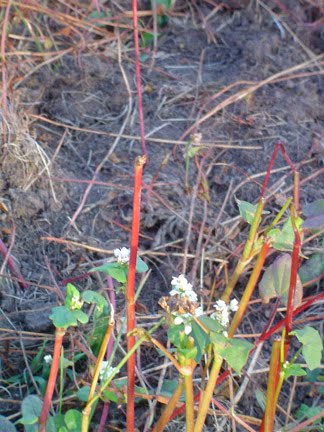
Remember the buckwheat? We had so much rain after that day, I wasn't sure what would happen to it. This has been such a cool soggy summer here, unlike everywhere else in the country. However, just a few days after the Seed Stomp the little seeds rallied and germinated like mad, allowing us to clearly see why farmers invest in mechanized seed spreading equipment.

However, machines aren't much good at building community spirit, nor do they provide great potluck meals for after the seeding, so I think we will still incorporate the social side of things into cover crop seeding for now. Which doesn't stop me from coveting one of these:


I love super specific tools, and farming can justify an endless array of them. Still, the toss-from-a-bucket-and-walk-it-in technique worked:


It was interesting to see results of the variation in spreading and stomping techniques- some rows were very evenly spread, some were incredibly thick in spots, and completely bare in others, some we must have just completely overlooked, and others it looked like someone just dumped the bucket out all in one place. I name no names. We all just need a bit more practice...

Things were progressing nicely, but then:


The Elk Herd Discovered The Buckwheat.

Which was actually the point of the whole exercise. You see, we hope to apply for funding assistance from the NRCS for several farm infrastructure improvement projects, one of which is to build an elk exclosure fence. If we wanted official funding assistance we had to demonstrate that

1. We are an agricultural operation, and
2. We have a pest problem.

The sowing of almost an acre of cover crop helped to establish the first point.


The second point was proved when I went out to check on the buckwheat fairly soon after it sprouted and found the field stomped all over, with great clumps of plants pulled out of the ground and then spat out again. I think at first the elk weren't quite sure what to make of buckwheat, but they pretty soon developed a taste for it.


Our friend Mark, who volunteers the the Wildlife Center of the North Coast next door to us, managed to document the second point for us, catching the perps In the Act.


They've been decimating the plot all summer long, and what they didn't destroy, lack of irrigation and some Very Hot Days (in and among the coldest, wettest summer in recent memory) did the rest.


It's a bit of a let down- we are expecting our sexy new BCS walk-behind tractor (it's Italian! So Stylish!) to arrive any day now which will allow us to till the buckwheat under and get a winter cover crop sown, but there is hardly anything left to till under. Except weeds. If you look closely, you will notice that the weeds are the only green thing in the picture.


At least we know something will grow there.

We need to get our winter cover crop sown very soon. It's hard to do that knowing that it is just going to meet the same fate as the buckwheat, but we can't leave the soil bare. Hopefully funding for the fence will be available sometime in the Spring, so we might actually be able to get something growing back there for next summer. Something besides weeds, I mean.

I have to spend a bit of time with our soil test results as well, and figure out how much lime we need to be applying to start shifting our ph, among other things. This is just the start of the soil building process, and I know it will take several years of attention before it is balanced enough to support growing annual row crops productively, but you've got to start somewhere.

Hopefully we'll have the damn fence up by the time our soil ph reaches neutral!

Friday, August 13, 2010

Back in the Saddle Again...


Well, back in business anyway. Sort of. After many months of delay, we finally have some plants for sale at the Astoria Co op.

"What, now?" I hear you say. "When summer is almost over?"

Aside from the fact that we have barely had a summer this year, this is the perfect time to get a late crop of leafy greens- lettuce, chard, kale- planted in you garden. No doubt the lettuce and other greens you planted at the beginning of the season are fading, and it's a good time to just harvest the lot of them, compost what's left of the plants and start fresh. The new plants will grow beautifully through late summer and autumn, and if winter isn't too harsh, and if you maybe give them a wee bit of protection when it gets super cold, you should be able to enjoy fresh greens pretty much through winter.


Mostly I'm just amazed that we managed to finally get the plants grown and get them to the store- it was flabbergasting how complicated it seemed to be to get one plant display put together with six flats of plants. When I think about what we used to do every weekend:


Whew. We'll have to get back in shape for next year.

I'll be bringing in extra plants this weekend as Saturday is Co op member discount day. There should be lots of people around to try and convince that it really isn't too late to plant greens.

It's fun to have plants for sale again. Even just while we were setting up the display, I had several great conversations with people who were asking about growing edible plants on the coast in the fall and winter, and it was so easy to slip back into Farm Girl mode and talk growing. I miss that.

So if you are in the area, and in need of a few leafy greens to fill out your fall garden, stop by the Astoria Co op soon- we don't have that many plants, and you should get them planted soon so their roots can get settled in for the coming season.

I'll leave you with a lovely bit of Farm Porn that I spotted the other day:


Note the black aphids, which is what I wish they were working on instead of each other. Still, if it all results in more ladybugs around the place, I guess it's ok.


Friday, July 23, 2010

Swarm!

I am relating events that took place about a month ago.

I can't believe it's taken this long to get it together to write this! I've just been remarkably busy- I'll resist the obvious analogy- and somehow it just kept slipping away from me. But it is a story well worth telling, with many lessons learned.

In late June, our bee hive swarmed.

Of course it was the week that Packy was away, so he missed the whole thing which was a shame, because it was Very, Very Cool.

I didn't notice them at first. It was a gorgeous warm, sunny day- the first we'd seen in way too long, and I was attempting to catch up on a million farm chores, mostly involving mowing. Not the most exciting chore, but so satisfying when it's done.

In one of the many back and forth trips to the house, I suddenly looked over and saw this on the fence:


Well, I was pretty sure what it was. I tried to get close enough to make sure that they were actually honey bees and not some other kind of flying buzzing insect, and then realized that I was foolishly trying to get very close to a buzzing mass of over-excited insects while wearing no protective gear. I decided to step back and call in an expert:


Oddly enough, I had just seen Thom a couple of days before at the inFARMation at the Coast event in Astoria, and he had given me one of his new business cards. Thom is a beekeeper,teacher, prolific blogger, and all-around interesting person. I enjoy when our paths cross, I always learn something. That day I learned that we don't know nearly enough to be the keepers of a bee hive. Thom was remarkably patient with me and my several thousand questions. Packy and I are both looking forward to taking his beekeeping class this winter to hopefully answer a few thousand more.

Thom assured me that yes, those were indeed honey bees swarming on the fence. He got a nuc box (which is a sort of temporary hive, 'nuc' is short for nucleus) out of the back of his truck, grabbed what looked like a drafting brush, donned his snappy bee jacket (with attached hood- so cool) and proceeded to pop the box open underneath where the bees were hanging out on the fence and then just brushed great clumps of bees into the box.


The bees were fairly annoyed by this, to say the least. Thom remained very cool, which I guess is something you develop over time as a beekeeper. Thankfully I managed to resist doing the panicky "Oh God there are a Huge Number of Bees Flying Around Me" dance. I just stood as far away as I could get and still see the action. I was wearing a protective hood, and long sleeves and gloves and all, but it was still a bit disconcerting to be that close to that many agitated bees.

Very Interesting Bee Fact that I Learned #1: Bees can sense their predators by the carbon dioxide that they exhale, so if you want a bee to stop following you around, hold your breath and back slowly away from it. Good to know.

Once Thom was sure that the queen bee was in the nuc box, he set the box on the ground near the fence.

"The rest of the hive will follow her into the box eventually," he assured me as I looked in worry at the hundreds of bees still lurking on the fence. "They can still scent the hormones she left on the fence, so they're confused, but they will find her."

Oddly enough, while Thom was busy wrangling our swarm, I got a call from our friends Jean-Marc and Kathleen, asking me if I happened to know of anyone that could take care of a swarm of bees that had showed up at their house that day.

"Weird..." I said to Thom. "Did some secret ultrasonic message go out to all the hives to swarm today?"

"No, it's just the first really warm day of the year," he observed. "This always happens. It's not great that the warm weather has come so late this year. It's almost to the point where the new hives won't be able to build up enough food stores for the winter, and you may have to feed them."

Very Interesting Bee Fact that I Learned #2: If bees swarm too late in the season, there aren't enough pollen producing plants around to allow them to build up adequate honey stores to last them until the following spring, and unless these hives are provided with additional food, they will probably die.

Thus the charming old English poem that Thom recited for me:

A swarm of bees in May is worth a load of hay.
A swarm of bees in June is worth a silver spoon.
A swarm of bees in July isn't worth a fly.

So, Thom left to go capture Jean-Marc and Kathleen's bees, and told me he would be back later to check on the nuc box and help me move it to a location near the old hive. We set it up on cinder blocks to keep it off the ground because-

Very Interesting Bee Fact that I Learned #3: Skunks are a voracious predator of bees, and keeping the hive off the ground can protect it from attack. Skunks will scratch at the entrance to the hive and then eat the adult bees who come out to investigate the disturbance. A hive can be seriously depleted if the skunk isn't stopped, so it was well worth hauling the cinder blocks out to the hive location to provide some extra protection.

I woke up the next day feeling pretty happy about the new bee hive, and looking forward to telling Packy all about the excitement. Imagine my consternation late in the day when I looked over and saw this:

The bees were back on the fence! In a very cool clumpy shape, true, but what had gone wrong?!

I called Thom, who was very puzzled, and theorized that perhaps it was because the hive had been left too close to where they had swarmed to the day before, and that maybe he should just take the swarm back to his place to 'reset' the hive's location, and then bring it back to our farm at a later date.

He heroically came out again to our farm to investigate, and did the first thing any curious beekeeper would do, ( I can't believe I didn't do this, such an idiot) he went to look at the nuc box to see if he could tell what went wrong.

Which is when he told me:

"So, yesterday's bees are still in the nuc box, and look very happy. It looks like your hive has swarmed twice!"

Well. I didn't know they did that, but apparently:

Very Interesting Bee Fact that I Learned #4: A bee hive can swarm several times in a season. The first time it is the old queen taking off with a large percentage of the worker bees accompanying her after one or more new queens have been born in the hive. Bee hives, much like Wild West towns and their gun slingers, aren't big enough for the both of them. Subsequent swarms would be with another of the virgin queens (I just love beekeeping terminology, so Elizabeth the First) and are usually not as big as the first swarm.

This time Thom sprayed the bees with water, which I think he said calmed them down, or at least stopped them from flying. Then out came the drafting brush again, and hive #2 was scraped off the fence into a second nuc box.


Beekeeping is a huge subject, and a lifetime of study and experience will still probably only scratch the surface. I am humbled to realize how much we need to learn in order to be good stewards of these phenomenal creatures, but I'm very much looking forward to learning it. Bees are just amazing.

And Thom is pretty damn amazing too.


Monday, June 14, 2010

(Semi) Wild


As a farmer growing flowers and vegetables for a living, I've never gotten very excited about deer, unless is was in a 'hopping up and down in a fury because some #$@%^$ deer had eaten all the sweet pea blooms off the trellis the day before market' kind of way.

My life has been full of odd coincidences, and one of my favourite ones is this: before we moved to the Oregon coast, we lived next door to a wildlife rescue and rehab center, WildCare. And our biggest neighbour here at 46 North Farm? A wildlife rescue and rehab center, the Wildlife Center of the North Coast.

Spooky, eh? What does it mean??

Well, mostly it means making our peace with the deer. One deer in particular.


Meet the (Semi) Wildlife

One day last winter I was in search of cedar boughs for an arrangement at the Blue Scorcher Bakery. I knew that we had a nice big cedar tree growing down along the quiet back pasture of the property, so I grabbed my loppers and saw and set off. As I got closer, I noticed that sitting not six feet from the tree was a large doe calmly contemplating the landscape. Nearby was a younger deer chomping on the grass- not quite a fawn, but not full grown yet. I felt a bit bad about flushing them out, but figured that they would come back as soon as I left, so I walked over to the tree and started lopping and sawing.

The deer just sat there calmly watching me, completely unfazed. The younger deer had frozen in that eyes wide, legs splayed pose that clearly says "my very small brain has completely seized up". It gradually went back to eating, cautiously watching me when it saw the older deer was unconcerned. When I walked off, dragging the branches behind me, the doe was still sitting right where I found it.

"My god the deer around here are brave," I commented to Packy when I got back to the house. He looked at me with resignation.
"Wildlife Center," he said.

Meet the Wildlife Center


A few days later I mentioned the incident to our friends Mark and Kristin who, in addition to being expert buckwheat seed sowers, also volunteer at WCNC.
"That must be Fawn Fawn!" Kristin said brightly. Packy was startled.
"The deer around here have names?! Is this a Disney movie??"

It turns out that Fawn Fawn had been brought to the WCNC as a young fawn after having been hit by a car.
"Her leg was broken, and she was in pretty bad shape," Mark told us.
They operated on her, fixed her leg, nursed her back to health and then released her. However, during the rehab phase she became very socialized to people, and has chosen to stay in the area. Safety and food are a big draw for deer.

We've gotten used to Fawn Fawn being around now. She's easy to recognize with her slightly wonky leg that makes a clicking noise when she runs, and she has a notch in one ear. Plus, the weird friendliness is a dead giveaway.

We later learned from Sharnelle Fee, founder of the WCNC , that Fawn Fawn is close to 11 years old- a remarkably old age for a deer. Also, she appears to be rather promiscuous.
"Most of the white-tail deer around here are her offspring," Sharnelle informed us with a wry smile. "She gives birth every year, and she often has twins."

Oh well, we sighed. We knew we couldn't farm here without fences.

Meet the Proud Godfather


Many people have noticed that there is a large vintage school bus parked down near the barn on our farm. The full story will have to wait for another post, but the short version is that our friend Israel (Guitar and Ukelele playing Buckwheat Seed Mule) is a (very talented) musician. The band he is in had spent a large part of last year touring around the US in a ten-seater van, and they had purchased the bus at the end of their tour with the idea of turning it into a more comfortable home away from home for while they are on the road.

What with one thing and another, the bus somehow ended up on our farm, being stripped and gutted and painted and reworked into what is going to be a pretty amazing ride. Sure, Willie Nelson's tour bus runs on bio-diesel, but does it also have salvaged old-growth hard wood floors and hand made bunks? I think not.

Most of the bus transformation work is being done by Luke (Greenhouse Saving Woodworker and Stand up Base Player Extraordinaire) and Kati (Row Digging Banjo Player who Wields a Mean Power Drill) with assistance from Ryan (Artistic Painting Drummer who Doesn't Know that he is going to be Roped into Helping Paint the Barn yet) and the afore mentioned multi-skilled Israel.

In thanks for our farm supplying the workspace for their Rebuilding the Bus project, the band has been tremendously helpful with our Rebuilding the Farm project, cheerfully pitching in to help us get our farm back up and running. It's been great having them around.

The band hadn't been working on the farm for very long before they noticed a rather friendly deer hanging around. Luke was especially charmed, and felt compelled to make closer contact.

"I'm going to go and hug that deer," he told Kati one day.

And so he did.


Luke seemed a little disappointed to learn that his close encounter had more to do with Fawn Fawn's social history and less to do with his extraordinarily powerful wildlife communication skills. Still, he and Fawn Fawn have gone on to form an especially close bond, and he gets a very goofy smile on his face when he sees her.

Meet the Kids

Luke's sister Renia (Professional WWOOFER and Accordian Playing Animal Whisperer) met Fawn Fawn for the first time when she came out for the greenhouse frame building-row digging day.

"That is one very pregnant deer," she observed.
"Oh. My. God." said Packy. "That little tramp!"

A few days later our paths crossed with Luke and Kati down by the barn.

"Fawn Fawn had fawns!" Luke told us, beaming. "Twins!"
"We almost stepped on them when we went over to see Fawn Fawn yesterday. They were curled up in the tall grass, hiding. They are so sweet!" Kati said.


We all agreed that little fawns all covered in white spots are shockingly cute. There was a collective wish that this story not follow the Bambi plot line.


I have to say, it has been great fun watching these two as they romp around the farm, bounding through the tall grass like oversized bunny rabbits. The family is usually accompanied by another doe- probably Fawn Fawn's fawn from last year. We have dubbed her 'The Au Pair'.


There are occasional turf wars and minor skirmishes with other groups of deer in the area, especially the Gang of Five (see above) that shows up with some regularity. Fawn Fawn usually makes short work of them if they get too close to her tribe. She may be a bit dim, but she knows where her boundaries are.


I can't say that Fawn Fawn is the best parent. She seems pretty casual about the whole thing, and I'm trying to not get attached to the outcome of this four-legged soap opera. In the last month there have been a number of hair raising 'Oh God They're Crossing the Highway' moments as Fawn Fawn casually strolls the family over the road to the forest across the way.


We are finding ways to protect the plants that really need protecting, resignedly watching the occasional pruning of the ones we can't protect, and waiting until we get a fence built before we plant anything that we can't afford to loose. Packy added a layer of deer netting to the greenhouse doorways after watching the Fawn Fawn gang casually stroll right on through one day, fortunately before there were any plants inside.

We know we share this piece of land with a lot of wildlife, some semi-wildlife, and even some musicians (who aren't too wild), and finding balance between everything here is part of the challenge, and part of the fun.